Why the need for research?

True insight is typically impossible without some kind of research. In our personal lives this may mean having a chat with a friend to decide which cellphone to buy, or googling a company when preparing for an interview. In business, research typically requires a review of available literature, case studies, specialist consultation etc. Research may take the shape of desktop research or field research. Primary research or secondary research. In fact there are many ways in which research may be categorised. Many ways in which it may be conducted, and countless applications.
A Solution-oriented approach

As a management consultancy, we at Redflank believe we are able to make the crucial difference with research through adopting a solution-oriented approach. To illustrate what we mean by a solution-oriented approach, let's use a real life example. Redflank was approached by a client to research retailers as potential distribution partners. The average research project would have typically approached this request with lots of information gathering and analysis.
Which is what we did. Except we started with a clear idea of what it was that the client wanted - for the business - not just from the project. When we conducted the research, we looked at how attractive each company that was analysed would be as a potential distribution partner, including how well each company's capabilities matched to the client's capabilities. We looked at feasibility, including strategic fit. When we spotted a high performing company, we conducted a more detailed case study - from which we extracted best practices. So what the client ended up with at the end of the project was not just a bunch of two-by-two graphs, or a doorstop analysis pack, but a set of strategic choices, together with the best practices required to turn these into decisions. The solution-oriented approach didn't just result in a list of potential distribution partners - the list was prioritised according to partnership attractiveness and feasiblity, coupled with an action plan, and a first-meeting discussion pack for each of the high priority companies. Thus, not just a research report, but a blueprint and a plan to get the first five distribution partners on board.
A solution-oriented approach implies that rather than just gathering and analysing data, there is a focus on working towards the solution that the research is meant to enable. This means a couple of things:
-
Understanding what key business outcome is required
-
Conducting the research with the end in mind
-
Ensuring that the research crystalizes best practices that help shape the solution
-
Creating a virtuous cycle between solution and research
These concepts are explored in further detail below.
1) Understanding what key business outcome is required

When a research request arises, it will typically be articulated in terms of the nature and the format of the information to be sourced. At the next level, people will talk about what insights must be generated. The key question to ask though, is what business outcome it is that needs to be enabled. Which businesses do you want to partner with? Do you just want a review of cluster-related government incentives, or are you more interested in the specific plans your cluster should implement to attract businesses to locate in your cluster? In the client project example above, is the key outcome just an encyclopedia of 105 company's details, or is it rather a successful partnership with an appropriate retailer to distribute products, ready to launch within 12 months. The business outcome required will require a solution to deliver it. And it is this solution (and the business outcome that it underpins) that we refer to when we talk about a solution-oriented approach.
2) Conducting research with the end in mind
Effective and efficient research is not easy. However much you may know at the start with regard to the subject matter being researched, you will find out more as the research progresses. And the more you find out the more avenues will open up, each needing further investigation. This presents significant scope and effort management challenges, as well as difficulties in deciding the direction for further steps in the research exercise.
Keeping the desired business outcome, and the associated solution in mind, when conducting research helps focus and direct the research exercise. For example, in the case of the client project mentioned above, the initial project scope was defined by the number of companies to be researched. Initial research indicated that some "companies" were actually groups of companies, sometimes with up to 20 subsidiaries, each subsidiary being a business in its own right. While the project sponsor agreed to prioritise these subsidiaries for further investigation, she was concerned about missing out on potential business partners. So the project team conducted sufficient analysis on all the companies to establish partnership feasibility and attractiveness, with only those companies meeting minimum thresholds being selected for further analysis. So although the ballooning project scope threatened to derail the project, keeping the end in mind ensured that the end project outcome was not compromised.
3) Ensuring the research crystalizes best practices that help shape the solution
When deciding what business solution will meet a required business outcome, it is useful to have points of reference in place to guide the solution definition. When building a house, the foundation lays the groundwork for the shape of the house. The walls create the space for fittings. The roof structure provides the framework for the roof tiles. Similarly the points of reference for a business solution provide the guidelines for the business solution. These points of reference could be solution guiding principles (e.g. the solution must be deployable across South Africa, including in rural areas), they could be required business outcomes (e.g. the companies identified must be a good strategic fit to our company), and they could be leading industry practices (e.g. Pick n Pay has pioneered the distribution of high value products without needing salesman on the shop floor by...). Best practices in particular play a critical role in helping shape the solution, typically because they provide solution direction that may otherwise appear arbitrary, helping the project propose similar solution choices as those taken by leading companies that have proven their choices through superior business performance.
4) Creating a virtuous cycle between solution and research

The "virtuous cycle" refers to research findings and solution thinking maturing alongside each other, each helping flesh out the other as they progress. Each key research finding helps flesh out the solution a bit more, with the research becoming more focused the clearer the solution becomes. So, in the client example above, the case studies conducted helped decide which retail sectors are more open to partnership, which helped decide which companies to conduct more indepth analysis on, which revealed which particular products are more amenable to being distributed through a distribution partner, which helped define the client's distribution business model, and so on.
Conducting research is challenging. High data volumes, statistical accuracy requirements, information access issues, evolving client expectations etc. can present seemingly insurmountable challenges.
At Redflank we employ various approaches to deal with such challenges. Experienced statisticians, who intimately understand such things as confidence intervals. Defined methodologies and tools, that translate into sharper focus, and greater efficiencies. Data warehouse specialists, who know how to interrogate system data. Field research specialists, who have conducted hundreds, if not thousands, of interviews. Case study specialists, who recognise leading industry practices when they see them. Amongst all of the levers that improve research outcomes, though, a solution-oriented mindset and approach is undoubtably the single element that makes the most difference. This is what provides the key guarantee that key business needs, rather than just research briefs, are addressed.
Turning Your Business Around
In a recessionary climate, there's understandably a lot of talk about what it takes to turn businesses around. Like the "I lost 30 kilos in 3 months, ask me how" diet or the get rich quick scheme, its typically the big-gain, low-effort turnaround strategy that draws the headlines. This probably derives from the phrase itself. Business turnaround. Implying dramatic, massive impact. Now while the team at Redflank understands that real benefits are seldom delivered without the proverbial blood, sweat, and tears, we also appreciate that a sizeable improvement in business performance is not only possible, but doable.
At Redflank we look at a business turnaround as a special case of a business needing to improve its business performance. So when dealing with a business turnaround project, many of the methodologies, tools, and specialist skills that would ordinarily be applied to a business improvement project are applicable. Of course the extent of improvement required is greater, and particular issues may be accorded a higher level of prominence upfront, based on any burning platforms associated with current poor business performance. With a business turnaround project, as with any business improvement exercise, a structured, yet practically oriented approach is required to confirm issues and opportunities for improvement. A complete business diagnostic, including financial and capability analysis, needs to be undertaken. The approach, methodologies, tools, and specialists to be applied to the project would depend on the particular business circumstances, and the findings from the Diagnostic
(click here for details on the Diagnostic)
So, as you may imagine, there's unfortunately no single silver bullet that will solve just any business turnaround problem. However, there are some rules of thumb that will help steer the troubled business in the right direction, e.g.
-
Getting the basics right
-
Knowing when to act
-
A bias-towards-action mindset
-
Getting downsizing right
-
When excellent not good enough.
Two of these rules of thumb are described in further detail below. To request further information on these, and other rules of thumb, or to find out more on Redflank's Business Turnaround approach
click here.
Getting the basics right
At some point in every business turnaround discussion, we are inevitably asked the same question: "so what am I doing wrong?". Although our responses naturally vary depending on the business, and on its circumstances, quite often four or so of the top ten issues pulling the business down tend to relate to basic business principles.
Lets take an example. In our very first discussion with a flagging luxury goods business, the conversation naturally led to to a discussion of the business value proposition, and zoned in particularly on pricing. "Cost plus", they explained. "A factor of 1.3 is what we apply", they expanded. When we asked how the resulting prices compared to the competition, however, management was at a bit of a loss. They suspected they were cheaper, but weren't sure. Now that got them thinking. But the penny really dropped when we asked why they were positioning lower pricing for a product that their customers' perceived as higher quality when compared to competing products. A simple example, but a good case in point for some business basics that a flagging business sometimes misses, typically not due to lack of talent or experience, but simply because management tends to be too close to the problem. Unable to see the woods for the trees.
And its not just the smaller business that faces such potential issues. We've often run into similar issues at much larger corporates. For example, we were called in to help address qualified audit findings for a leading financial services company. Core issues related to creaking business and technology infrastructure, stemming from a number of years of rapid business growth, that had severely taxed limited business capabilities over the years. In investigating the causes of the overtaxed business and technology capabilities, we discovered that a new business unit was monopolising much of the existing infrastructure at the expense of existing, otherwise highly profitable, business units. A garden-variety case of profitability analysis and resource planning, you may say. And it was. Though management seemed surprised to hear this when we pointed it out.
Fixing business basics may seem too much of a panacea to what is typically a complex problem. And approaching business turnarounds with a "silver bullet" mindset, when tackling the basics can certainly be dangerous. What is key is that the choice of which business basics to focus on is supported by the requisite analysis, and by the appropriate level of specialist skills and experience. And bearing in mind, that business basics will only address part of the problem.
For details on how to get business basics right,
click here for information on reviewing your business basics, in Redflank speak, conducting a Diagnostic, or
click here for selecting and defining the competitive business capabilities that will ensure the correct business basics are in place to support your business strategy.
Getting downsizing right
When the bottom falls out, management is understandably under immense pressure to turn things around quickly. The Board tends not to be particularly patient when the share price is plumetting, and management will typically be under even greater stress when it's just a handful of private investors money at stake.
The easiest solution often appears to be to cut costs, and to cut them 1) visibly, and 2) quickly. Both these approaches present challenges. Visible cost cutting may take the form of management's decision to freeze the coffee budget or to put in gatekeeper in charge of the stationery cupboard. The typically perceived low hanging fruit though, tends to be staff reductions, or as they are euphemistically referred to, downsizing. A big plus with downsizing is that it translates directly into month -on-month cost savings. Given the amount of brand destruction opportunities they present though, and given the potential negative impact from reduction in business capabilities, downsizing needs to be handled very carefully.
The first decision to be taken when considering downsizing is what impact this will have on revenues and operational effectiveness and efficiencies. Is the resulting reduced business capacity and capability going to require a reduction in business volumes, will it impact the quality of service provided to customers, and will that perhaps result in an increase in client attrition? Is the business running the risk that 6 months down the line certain services may need to be outsourced, at a potentially higher cost, to ensure customer service and sales are not impacted? This may sound like a ridiculous scenario, but a real-life scenario we were approached to help address for a client.
Should a business be planning to downsize its staff complement, simply asking each division to decide which 10% of staff to cut from the payroll will probably not produce the desired results. The reason for this should be obvious. Turning a poorly performing business around is ultimately aimed at improving profitability, and that means reducing costs while avoiding counterproductive impacts on revenue. So when reducing headcount, carefull planning is required to understand which areas are potentially overstaffed, what capabilities could be leveraged, or implemented to improve efficiencies, and what changes may make a more effective way of running the business possible.
Naturally a key consideration is how to handle the people impact. Planning, and communication here is key. All too often the first people to leave are the ones you'd really have preferred to keep. And little slights, that could be easily avoided, can just as easily turn a loyal employee into a bitter brand-destroying enemy.
Staff rightsizing is often necessary. Though typically poorly handled. Keeping some of the points above in mind when embarking on such a journey can make the crucial difference between a business and public relations nightmare, and a successful business turnaround.
To request assistance with your Downsizing exercise, or to request further insights click here.
Competitive Business Capabilities

The business environment has become, and continues to be, increasingly competititive. In the quest to improve returns for shareholders, the need for a business to differentiate itself from competitors is an ongoing challenge. Without such differentiation, businesses face the risk of declining market share and profitability. Shareholders risk a drop in share price, management faces replacement, and employees stand to lose jobs. Clearly then, developing and maintaining a competitive edge is a crucial imperative for any business.At face value, there are many ways for a business to create a competitive edge.
Product companies such as Apple do this through their keen sense of what products appeal to the market, and their attendant product design and development capabilities - leaving production and distribution to a multitude of partner companies. Other companies, for example, retailers such as MassMart, use their channel presence to provide product manufacturers with access to superior distribution footprints . Successful companies such as these have managed to formulate clear strategies for competitive differentiation, and have built the appropriate capabilities to enable the delivery of such strategies. Clearly defined business capabilities underpinning a company's ability to differentiate itself from its competitors are critical to business survival and performance improvement.
What are competitive business capabilities, exactly?

Redflank defines a business capability as anything that provides a business with the ability to do something specific. A simple, fairly broad definition. For a business capability to be competitive, it needs to provide the business with the ability to do something that provides competitive advantage. Lets use an example. Two companies , Company X and Company Y, may both have a workflow business capability. What may make Company X's workflow capability competitive is the ability it provides for the flow of work to be directed over multiple locations across the world. An event driven, rules-based workflow system, coupled with flexible processes, and the skilled staff to operate in such a dynamic environment may be what underpins such a workflow capability. Company Y, on the other hand may still be using hardcopy diaries to manage the flow of work in its business. If Company X and Company Y were both courier companies, you can imagine how company Y would stuggle to provide a competitive offering to a customer wanting to deliver a package across the world, while Company X would consider such a requirement simply another typical day's work.
To recap. A competitive business capability is something that provides a business with the ability to do something in a way that provides competitive advantage. This "something" typically consists of various constituent components, namely operations, organisational, technology, and infrastructure components. In the example above, the competitive workflow capability consisted of a workflow system, the associated business processes, and the people responsible for the activities managed by the workflow.
Redflank has identified 369 key competitive business capabilities. Some of these are industry specific (e.g. the Risk Segmentation capability that applies to financial services companies, or the Software Innovation capability that applies to ICT companies) while others apply to all businesses (e.g. the Client Insight capability or the Process Flexibility capability), irrespective of industry. These 369 competitive business capabilities are based on extensive research into business best practices and have been shaped by hundreds of years' collective specialist experience from the Redflank team. These competitive capabilities are housed in Redflank's Best Practice Capability Framework tool.
The following is a sample of Core Competitive Business Capability:
Workflow Management
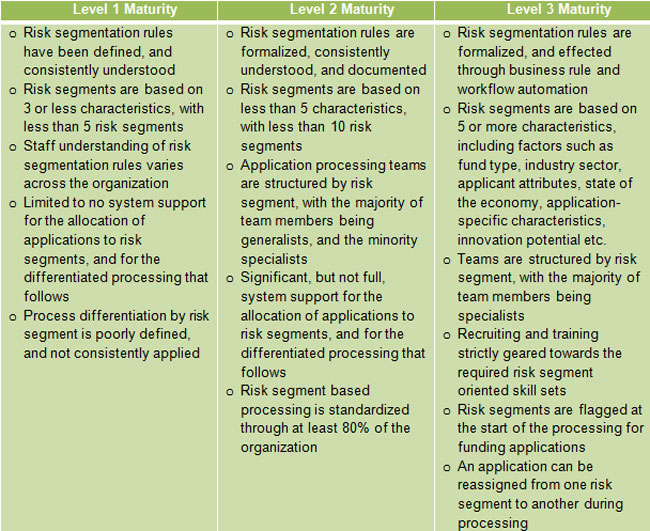
Core capabilities are the lowest level in the capability hierachy. Core capabilities are grouped into Capability Groups, which are then grouped in Business Functions etc. The definition for a core capability includes a description of the capability characteristics associated with each of three industry-standard, best practice maturity levels. The higher the level , the higher the maturity of the capability.
How to create and maintain competitive business capabilities?
-
The first step to putting competitive business capabilities in place requires having a clear strategy that helps identify the ways the company expects to differentiate itself from its competitors. In the examples above, the strategy for a company such as Apple may hinge on product innovation and exceptional business parterships. In the case of your particular company, you may have recently revised or developed your company's business strategy, in which case no further work would be required for this stage. Should the Company Strategy still need to be developed, or require refreshing.
-
Step two involves the identification of appropriate capabilities for the company and its business strategy, based on Redflank's Best Practice Capability Framework tool. Once the appropriate capabilities are selected, a careful examination of the Business Strategy is required to define the target capability maturity levels that will be required to deliver the business strategy. The tool is fully electronic, so allows for ease of capability selection and assigning of capability maturity levels.
-
The third step requires the definition of current capability maturity levels for the selected capabilities. Steps 2 and 3 are standard activities as included in Redflank's Diagnostic offering.
-
Step four involves the idenfication of gaps between current and target capability levels, thus earmarking those capabilities that need to be created, or enhanced, to deliver the level of maturity required to support the Business Strategy.
-
The last step, as you would imagine, is to put in place the initiatives required to address the capability gaps identified in the previous step. Projects thus identified have the benefit of being assured of focusing on the appropriate business capabilities, so there are no nasty surprises on completion of these projects with regard to whether or not the project outcomes meet the strategic needs of the business.
Capability Maps
Capability maps are graphic illustrations of capability maturity levels for a group of core capabilities. They are particularly useful for presentations at management level, as they provide a visual, holistic view of competitive capabilities while allowing quick and effective drilldown to a lower level of detail. They are simple, easy to understand, and provide for ease of comparison across geographies, industries, and time. See below for examples.
Making competitive business capabilities work for your business
Here are some tips on how to approach competitive business capabilities:
-
Bigger is not always better
When selecting the maturity level for a particular business capability, the appropriate rather than the highest maturity level is what is required. Take the example of capability analysis undertaken by Redflank at a Nigerian financial services group that was identified as a potential acquisition target. Measurement of the Nigerian company's Workforce Specialisation capability indicated that this capability was already operating at the maximum level of maturity, much higher than for comparable South African companies. This seemed surprising, given the deep financial services skills available in South Africa - until the realisation that the South African companies' sophisticated systems provided the support that enabled them to employ much lower skilled resources. The Nigerian company had correctly set its Workforce Specialisation capability to the maximum, given its people-intensive strategy, as opposed to the South African companies it was compared with, which had selected the maturity level appropriate to their technology-intensive philosophy.
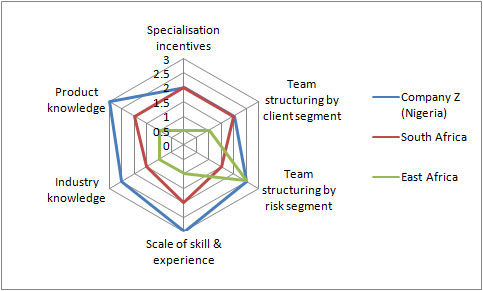
In the Workforce Specialisation Capability Mapping diagram above it should be clear that the Nigerian company's workforce specialisation capabilities are generally superior to the corresponding capabilities for both South African and East African companies. Interestingly the Nigerian's company's capabilities far exceed those of East African companies for all core capabilities except for Team Structuring by Risk Segment, for which both regions have similar capability maturity levels, perhaps due to the extreme focus on fraud management in countries such as Nigeria and Kenya.
-
Using Capability Benchmarking as a decision-making tool
The Best Practice Capability Framework may be used to benchmark a company's business capabilities against comparable companies and industries. This is done by comparing the maturity level for each relevant capability against the maturity level for the comparable industry. Industries compared to could be selected on a geographic basis (e.g. local, regional, global) or on a sectoral basis (e.g similar sectors, contrasting sectors etc.). This is an incredibly useful way to understand how competitive a company's capabilities are. By comparing to industry leaders in particular fields, it is also possible to understand where your company's capabilities may lag, or even lead, demonstrated best practice. Redflank has employed such comparison's to highlight various opportunities for improvement, sometimes resulting in enhancement of existing capabilities, and at times enabling redirection of investment away from capabilities that do not align to the company's strategic direction. Current business capabilities may also be benchmarked against historical, as well as planned, business capabilities, thus providing a view of changes in capabilities over time.
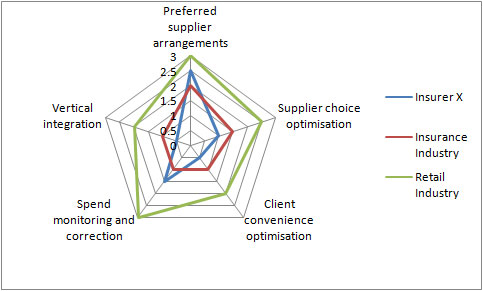
With regard to the illustrative capability map above, it can be seen at a glance that Insurer X's Procurement capabilities are not far off from the maturity levels for the insurance industry generally, but lag far behind the capability levels for the Retail industry. This indicates a clear opportunity for Company X to leapfrog its insurance competitors by adopting cross-industry retailer Procurement practices.
-
Getting best bang for each strategy project buck
By mapping current and target (i.e. future, or planned) business capabilities on the same capability diagrams (see capability map below) it is possible to simply and clearly identify where capability gaps exist. These gaps would indicate a difference in maturity level between the current and target capability, thus putting business leadership in a position to clearly understand which capabilities are not at the level of maturity required to support the company's strategic plans. A decision can then be made to enhance particular capabilities to raise their maturity level, or to shift focus away from other capabilities (where current maturity levels exceed target capability levels). What is also great about the clarity provided by mapping current and target maturity levels for business capabilities is that it allows informed planning and prioritisation of the various projects that may be intended (or already underway), in support of delivering a company's business strategy. It could, in fact, be argued that any project that does not move capabilities from their current maturity level, to the target maturity level required by the business strategy, would need to be reviewed to confirm its business case.
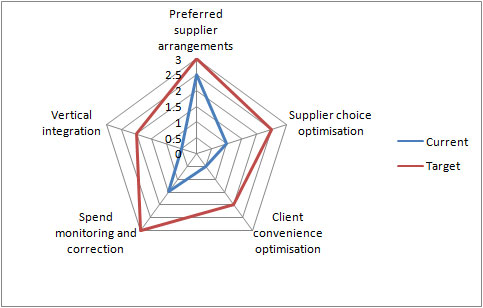
In the illustrative capability map above, continued on from the example in point 2, Insurer X has decided to set its target Procurement capability levels to that currently in place for the Retail industry, thus positioning itself to streak ahead of its competitors by adopting cross-industry Procurement best practice. The space between the red and blue lines thus indicates the overall Procurement capability gap that would need to addressed to realise Insurer X's best-practice Procurement vision. This provides a clear way forward with regard to the projects that would need to be launched, as well as a measure of the projects' success once they are completed.
To Recap
In today's demanding business environment, creating and maintaining a competitive business edge is critical to business success. Competitive business capabilities are what make this competitive edge possible, and sustainable.
Redflank's Best Practice Capability Framework software provides the intellectual capital that makes the design of competitive business capabilities possible, as well as providing a tool that guides businesses through the process of selecting, defining, and putting the required competitive business capabilities in place. The Best Practice Capability Framework tool may also be used for Strategy formulation, business diagnostics, due diligences, industry benchmarking, and the generation of business requirements.
Competitive Business Capabilities

Almost every person who has been exposed to systems implementations, whether as part of a project team, or as a business sponsor or other business representative, will have a horror story to tell. This is hardly surprising, considering that the average cost overrun on software projects is a staggering 189% of the original cost estimate, and the average time overrun is an unbelievable 222% of the original time estimate.
Systems implementation projects can be complex, which certainly contributes to the poor outcomes, cost overruns, and delays that dog a large percentage of projects. However, poor planning, and poor expectation management and decision-making during the course of a project, definately make what is typically a difficult situation much worse.
Redflank's extensive experience with system implementations has highlighted some of the common pitfalls that dog the typical systems implementation, e.g.
-
Misalignment of expectations
-
Poor choice of solution
-
Uninformed, optimistic planning
-
Misplaced, inadequate resourcing
-
Superficial testing
-
Inadequate risk management.
Two of these pitfalls, together with some suggestions on how to address them, are described in further detail below.
Poor choice of solution
One of the most disheartening things for staff is to have to work with a system that does not adequately support the needs of the business. Such situations typically arise when a software system has been poorly implemented, or has proven to be a poor choice for the systems support that the business requires. Once a poor choice of software system has been made, and money has changed hands, little can be done, other than to panel beat out of it the functionality required, or to live with a poorly functioning system. Given that the first option is typically a high, and unbudgetted, cost, most project sponsors typically opt for the second option. Which leaves staff with a poorly functioning system they need to work around, or even worse, pretend to use.
To avoid poorly functioning systems, it is critical that the appropriate software system, and assoicated vendor, is chosen.
An appropriate choice of software starts with a clear understanding of what it is that the business requires from a new software system. This should cover current and future needs. It should include a consideration of the kind of system functionality and system performance that is required. It should cover the "what" that the system must do, and where relevant go beyond this to the "how" it should be done. Specification of business requirements should take cognisance of the way the business operates as well as the way the business is organised. Clearly articulating what it is that the business expects from the system is the first step towards ensuring the appropriate software is chosen. Such considerations must seem fairly obvious, but unfortunately poorly articulated business requirements tend to be the norm, rather than the exception. Getting the business requirements right is a function of using proven methodologies as well as leveraging experienced systems implementation resources, that have an understanding of the industry.
A second key consideration is that while choice of software may appear paramount, it is important to note that what you are really choosing is the vendor providing the software, in addition to the software the vendor will be providing. In some ways the vendor plays a much more crucial role than the software itself.
Understanding vendor psychology is critical. For example: for smaller system vendors, software is the most profitable sale they can make. The cost of a sale is typically minor compared to the revenues to be generated from the software itself, which makes software a high margin item. Implementation services (e.g. making a vendor resource available to configure the software), on the other hand, are much lower margin items for the vendor. Implementation resources are typically billed on a cost plus basis. Customisation services (i.e. alteration of software) tend to be the lowest margin vendor services of all. Taking the above economic reality into account, a smaller system vendor is likely to understate implementation and customisation effort for your system implementation, in order to free up his resources to make the next software sale. Having that knowledge as a backdrop to your vendor selection decision can make the crucial difference between a system that enables your busienss versus a system your staff have to work around.
Bearing the above points in mind, it is critical that the software (and implied vendor selection) is undertaken in a structured and managed fashion, and that this process is guided by experienced specialists, each with a strong systems and business background, and supported by the requisite tools. Ultimately, the goal is to find a software vendor that is a good fit, not just for the system requirements, but also for the business culture, delivery needs, longer term relationship expectations etc. Getting little things right, such as conducting reference checks with other companies that have implemented the software previously, can make all the difference.
Uninformed, over optimistic planning

Systems implementations seldom proceed exactly as expected. Given their complex nature, and given the flurry of risks and issues that the typical project faces, various situations are likely to arise, all of which cannot be practically anticipated. It is natural, therefore, to accept that systems implementations at times will not proceed to plan, and that delays and drops in quality may sometimes need to be accommodated.
This does not mean that systems implementations should not be preceded by intensive planning. Failure to do so, or to plan assuming that things will generally be fine, is probably the easiest route to a systems implementation disaster.
Lets look at a classical example. Napoleon is rumoured to have spent days and weeks locked up in his rooms, studying maps of Europe exhaustively in advance of a military campaign. This preparation provided him with the insights required to continuously work towards his intended goals during a war, despite the varied situations that presented during particular battles. During a military campaign, this planning allowed him to make rapid, yet informed decisions based on knowing the terrain, and having thought through various scenarios, in advance of actually encountering them.
Though less grandiose that the average Napoleonic military campaign, systems implementations would also benefit from such informed, flexible advance planning.
Some rules of thumb to bear in mind with regard to systems planning:
-
Ensure the team doing the planning has actual extensive experience implementing systems, ideally of a similar nature. Supplement with deep specialists in particular areas where required.
-
Bear in mind the big ticket items driving the extent of systems implementation effort required. These are typically: extent of customisation, data migration requirements, integration requirements, and reporting requirements.
-
Factor in vendor capability, as well as business user skills and experience, into planned effort and schedule
-
Think through key relevant risks, and plan mitigation strategies, and well as likely approaches to address should any of these risks materialise into issues
-
Ensure that planned effort and timelines include contingencies for unforeseen risks and issues
-
Resource right
-
Undertake critical path planning
-
Keep the plan practical
-
Know where the systems implementation plan can flex, and where it must not give way. Having people with the right experience is critical to being able to make these calls.
-
Plan at a level of detail appropriate to what is known at any given stage. Do not plan below the level of detail available.